
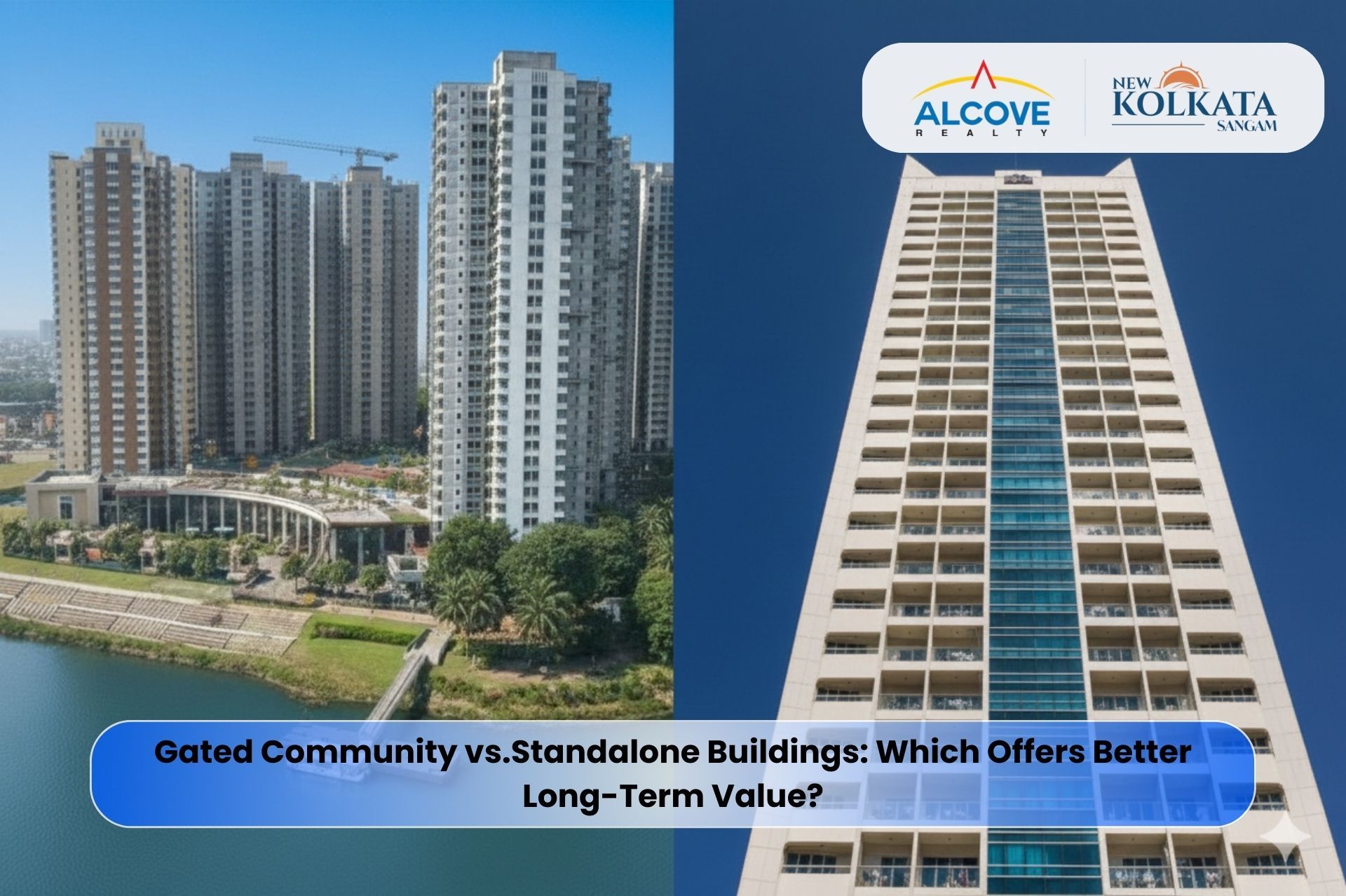
Gated Community vs.Standalone Buildings: Which Offers Better Long-Term Value?
1. Introduction
Homebuyers today are exploring multiple residential formats as cities expand and lifestyle priorities shift. Many homebuyers find themselves pausing at one key question: Should they choose a gated community or a standalone building?
This decision goes beyond layout and pricing. It directly affects comfort, safety, and long-term property value. Based on on-ground market behaviour, homebuyer interactions, and regional demand patterns, this comparison looks at how both housing formats perform over time and which one aligns better with evolving living expectations.
2. Understanding the Basics
What Is a Gated Community?
A gated community is a planned residential development with controlled entry and shared facilities. These developments usually include security, landscaped spaces, children’s play zones, and dedicated common areas. Through the years, the gated community format has become more and more popular due to its organised living and predictable maintenance.
What Is a Standalone Building?
A standalone building is defined as a self-contained residential structure, generally with fewer units and minimal common facilities in the case of such buildings. A standalone building frequently provides residents with a simpler lifestyle, lower maintenance costs, and increased independence.
3. Key Comparison Factors
Security and Safety
Security is one of the most important factors that separates gated communities and non-gated communities. An access-controlled community usually provides security against trespassers who can be seen through its camera-supported surveillance, entry and exit points, which are monitored by security officers.
Amenities and Lifestyle
In making choices regarding the place to live, lifestyle is the factor that has the highest weight in determining the outcome. Living in a gated community often includes the use of parks, which are common, walking paths, fitness areas, and indoor recreation spaces. The advantages of these facilities make life easier without having to go out of the community.
Space, Layout & Privacy
Homes within a gated community are usually planned with efficient layouts and open spaces that ensure light and ventilation. The shared planning approach brings uniformity and comfort. A standalone building may offer higher privacy due to fewer neighbours, though layouts and space utilisation depend largely on the builder and plot size.
Neighborhood & Community Environment
A gated community encourages interaction through shared spaces and organised activities, creating a sense of belonging. For many families, this social fabric becomes an important part of daily life. A standalone building suits homebuyers who prefer independent living and minimal interaction beyond immediate neighbours.
4. Long-Term Investment Value
Property Appreciation Trends
Market observations show that a gated community tends to appreciate steadily, especially in growth corridors. Planned infrastructure and amenities keep demand consistent. The value of a standalone building is more dependent on surrounding development and municipal upgrades.
Comparison of Resale Values
The demand for resale has been increasingly inclined towards a secure community area, and the main reason for this trend is the preference of tenants and homebuyers for security and lifestyle features. This demand positively affects the resale cycles and makes them healthier.
Demand for Rentals and Income Possibility
Tenants usually like to go for a house in a gated community because of the services and security, which makes the rental market stronger. So, such houses then become a good long-term property investment.
5. Maintenance & Upkeep
Maintenance Charges
Maintenance in a gated community is higher but structured. Residents contribute towards professional services that preserve the property’s condition.
A standalone building has lower routine costs, though expenses can arise unpredictably when repairs are required.
Long-Term Building Health
Regular audits and professional facility management help a gated community maintain consistent quality over decades, supporting its identity as a reliable long-term property. A standalone building relies on collective owner decisions, which can impact maintenance timelines.
6. Cost & Affordability
Initial Purchase Cost
Homes in a gated community are typically priced higher due to infrastructure and amenities. Homebuyers view this as an upfront investment in lifestyle and security. A standalone building usually offers a lower entry price, appealing to first-time or budget-focused homebuyers.
Hidden or Additional Charges
While a gated community includes association fees and amenity charges, these costs are transparent and planned. In a standalone building, unexpected repair expenses may arise without advance budgeting.
7. Who Should Choose What?
Best for Families
Families often prefer a gated community for safety, open spaces, and a child-friendly environment that supports daily routines.
Best for Investors
From an investment point, a gated community in an emerging location offers stronger rental demand and consistent appreciation, aligning well with a long-term property strategy.
Best for Budget-Conscious homebuyers
Homebuyers prioritising affordability and central locations may find a standalone building better suited to their needs.
8. Conclusion
The decision on whether to go for a gated community or a separate building rests on one's life priorities, investment plans, and vision for the future. Although both options tackle distinct requirements, the organised developments keep getting popular because of their certainty and constant value.
New Kolkata Sangam is one of the projects embodying the residential landscape change of the region and providing the living options that are technology as well as future-oriented. For those looking at Flats in Serampore, an understanding of this comparison not only helps to make a confident and informed choice that guarantees both present comfort and future value.
