
Why Serampore Feels Like Banaras: The Spiritual Pull of Living Beside the Ganga
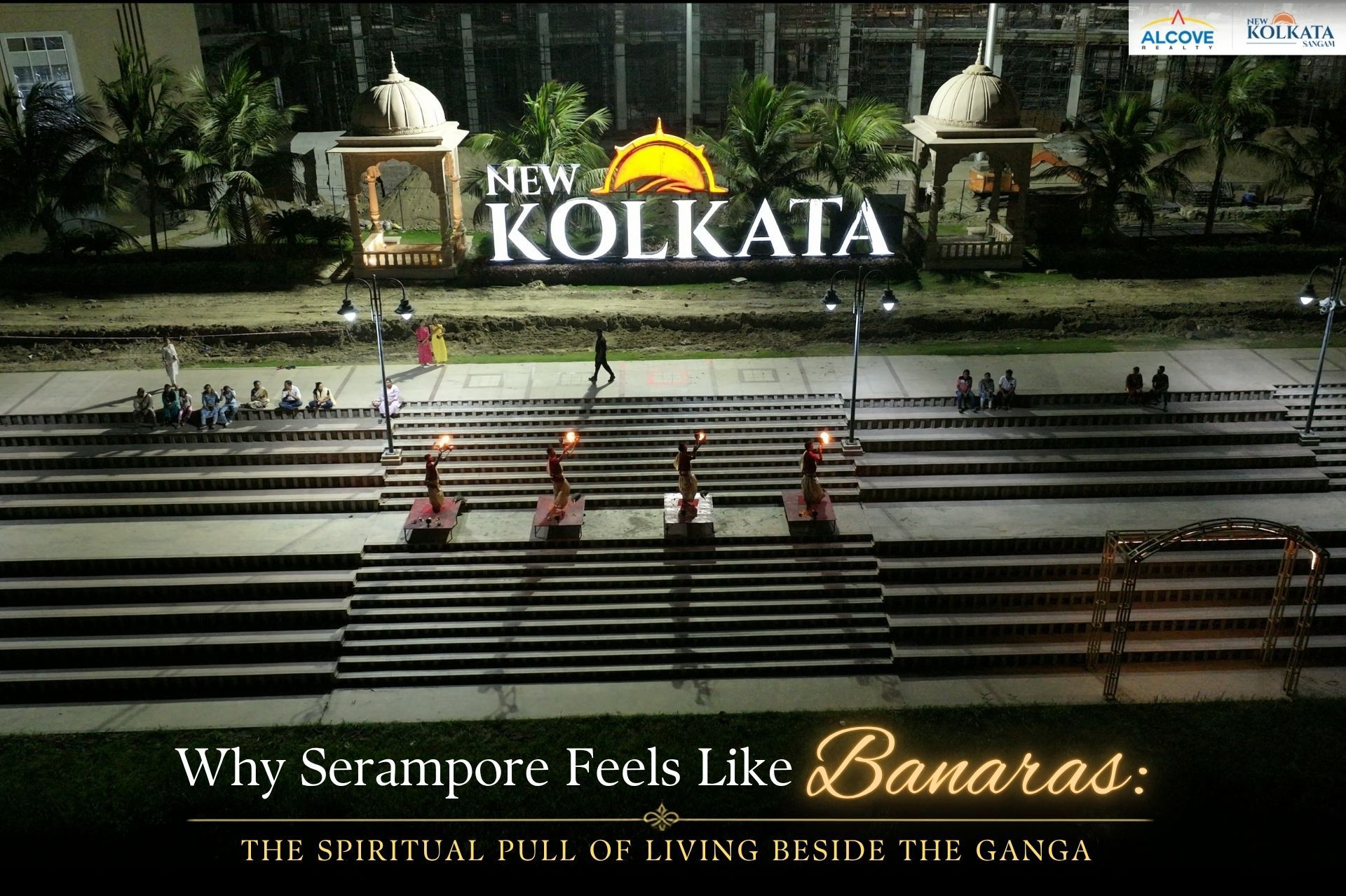
There is a particular quality to the light on a river at five in the morning. Anyone who has stood on the ghats at Banaras knows it. What fewer people know is that you can find the same thing about an hour from central Kolkata, in a town most of India has never heard of.
At New Kolkata Sangam, residents experience that riverside heritage every morning — from a township built directly on the banks of the Ganga at Serampore, where the day begins with lamps at the water's edge rather than a car horn. It is one of the very few addresses in India where the sacred Ganga aarti is not a journey you plan, but a sound you wake up to.
Serampore itself does not advertise. It has no tourist circuit, no ticketed sunrise boat ride. But it sits on the west bank of the Hooghly with a Jagannath temple whose worship goes back to the fourteenth century, a chariot festival older than most Indian cities, a Danish colonial quarter, and a stretch of river where people still come down to the water before work. The resemblance to Banaras is not marketing. It is geography and six centuries of habit.
The ghats at dawn: Serampore's own Ganga aarti
The comparison people make first is the aarti. In Varanasi it is a spectacle — brass lamps, crowds, the great tiered theatre of Dashashwamedh. In Serampore it is quieter and closer to the ground. Lamps are lit at the water's edge, the bell carries further than you expect across an empty river, and the whole thing is over before the traffic on G.T. Road properly starts.
At New Kolkata Sangam, this is not something residents travel to. The township has its own private ghat and deepmala on the Ganga, with an aarti held here every single day. It is an unusual thing to have at the edge of a residential address: not a view of the river, but a relationship with it. You can see how that ghat sits within the wider township on the project's amenities page.
Why the Ganga is sacred, and why the Hooghly counts
A reasonable question follows. Is this actually the Ganga, or a river that merely shares its water?
Both. Below Farakka the Ganga divides. One arm becomes the Padma and flows into Bangladesh. The other flows south through Bengal as the Bhagirathi-Hooghly, and it is this arm that Bengal has treated as the Ganga for as long as anyone has kept records. Locals here do not say "Hooghly river" when they are talking about faith. They say Ganga.
The importance of the Ganga in Indian life has never been only about hydrology. It is about a river that people organise a life around: the morning dip, the immersion after a death, the festivals timed to it. Serampore has done all of this for centuries without ever becoming a pilgrimage destination — which is precisely what makes it liveable.
Mahesh, and a Rath Yatra from 1396
Roughly 350 metres from the New Kolkata Sangam gate stands the Jagannath temple at Mahesh. Its Rath Yatra, celebrated since 1396 CE, is the oldest chariot festival in Bengal and the second oldest in India after Puri's.
The legend is worth knowing. The sage Dhrubananda travelled to Puri wanting to offer the Lord food cooked with his own hands, was refused, and in a dream was told to return to a place called Mahesh on the bank of the Ganga and begin worship there. The original shrine was lost as the river shifted course; the temple standing today was built by the Mallick family of Pathuriaghata, Kolkata. The iron chariot that rolls each year — four storeys, roughly 50 feet tall, twelve iron wheels, about 125 tonnes — was built in 1885 by the Martin Burn Company. Two to three lakh people come for it.
For a household living 350 metres away, this is the practical difference between reading about a festival and living inside one. Bengal's oldest Rath Yatra is not a day trip. It is your neighbourhood, once a year, for eight days.
Serampore's Danish colony and its river-facing past
Serampore's second identity is stranger. From 1755 to 1845 this was Frederiksnagore, a Danish trading post named for King Frederik V, run by the Danish Asiatic Company under permission from the Mughal governor of Bengal.
The Danes built close to a hundred structures here. Serampore College, founded in 1818 and granted a Royal Charter in 1827, became the third university of the Danish realm alongside Copenhagen and Kiel. The presses at Serampore produced Samachar Darpan and The Friend of India, which in time became The Statesman.
Much of it survived. Since 2008 the National Museum of Denmark's Serampore Initiative, working with the Realdania foundation and the West Bengal government, has been restoring the riverfront quarter. St Olav's Church, completed in 1806, was restored between 2013 and 2016 and received the UNESCO Award of Distinction at the 2016 Asia-Pacific Awards for Cultural Heritage Conservation.
Banaras and Serampore: the same river, two histories
The honest difference is scale and fame. The Banaras ghats run for kilometres and carry the weight of a city that has been continuously sacred for millennia. Varanasi is the destination. Serampore's riverfront is a working town's edge.
What the two share is the arrangement of life around water. Steps down to the river rather than a wall against it. Ritual at fixed hours. A funeral ghat and a bathing ghat within sight of each other. The sense — difficult to argue with once you have felt it — that the river is the oldest resident.
If Banaras is the pilgrimage, Serampore is the version you can live in, on a Tuesday, without taking leave.
What spiritual living beside the Ganga looks like day to day
Less dramatic than the brochure version. It looks like walking down to the ghat before the day begins. Bells from Mahesh reaching your balcony. Knowing which week the chariot moves and planning around it. Immersions in the season. Water in front of you instead of another tower.
There is a plainer benefit too: many residents appreciate the open riverfront and the breeze off the water, especially through the warmer months — one reason an open river frontage is valued so highly in a Bengal summer.
Chandannagar, Bandel and the Hooghly's other river towns
Serampore is one stop on a strange, layered stretch. Chandannagar upriver was French, and its Jagaddhatri Puja and lit-up Strand promenade draw crowds every year. Bandel Church, founded by the Portuguese around the turn of the seventeenth century, is among the oldest Christian churches in Bengal. Chinsurah was Dutch.
Four European powers within an hour of each other on one riverbank — and beneath all of it, a Jagannath tradition older than any of them. Weekends here have somewhere to go. The full picture of what sits within reach is mapped on the location page.
Living here: what it takes to own a home beside the Ganga
New Kolkata Sangam by Alcove Realty sits on 19 acres directly on the Hooghly at Serampore, where 3,800+ families have booked a flat. The township has over 65 amenities and a 56,000 sq ft clubhouse — the largest residential clubhouse in Hooghly. Homes run from 1 to 4 BHK, roughly 567 to 2,085 sq ft, across the Sangam Serenity, Signature and Suite collections.
Rishra and Serampore stations are 11 and 13 minutes away, Dakshineswar around 37 minutes, and the Serampore address places you inside the Kolkata Metropolitan Area rather than outside it. Apartments in Serampore still price well below comparable flats in Kolkata proper — which is the part of this that tends to surprise people last.
Frequently asked questions
- Is Serampore on the Ganga?
Yes. Serampore stands on the west bank of the Bhagirathi-Hooghly in Hooghly district, West Bengal — the arm of the Ganga that flows south through Bengal after the river divides below Farakka. Its ghats, its temples and its daily rituals have all been organised around that river for centuries. - Is the Hooghly considered the Ganga?
In Bengal, yes. Below Farakka the Ganga splits into two arms: the Padma, which flows into Bangladesh, and the Bhagirathi-Hooghly, which flows south through Bengal. Religiously and traditionally, the Bhagirathi-Hooghly is treated as the Ganga — which is why aarti, ritual bathing and immersions are performed on its banks at Serampore exactly as they are upriver. - Which is the oldest Rath Yatra in Bengal?
The Mahesh Rath Yatra at Serampore, celebrated since 1396 CE. It is the oldest chariot festival in Bengal and the second oldest in India after Puri's. The present iron chariot — around 50 feet tall, four storeys, twelve wheels — was built in 1885 by the Martin Burn Company, and the festival draws two to three lakh people each year. The Mahesh temple is roughly 350 metres from New Kolkata Sangam. - Is Serampore a good place to buy a home?
For many buyers, yes. Serampore sits within the Kolkata Metropolitan Area, has direct rail connectivity to Howrah, established schools, colleges and hospitals, and a riverfront that cannot be built over. Per-square-foot prices remain considerably lower than comparable addresses in Kolkata proper, which is why the corridor has drawn steady end-user and investor interest. - What are the benefits of living beside the Ganga?
An open, permanent river frontage that no future construction can block; an unbroken view and daily access to the water; proximity to festivals and rituals that shape the local calendar; and, for many residents, the openness and breeze of a riverfront setting through the warmer months. There is also the simple scarcity of it — very few residential addresses in the region sit directly on the Ganga with a private ghat. - How far is Serampore from Kolkata?
About 20 km from Howrah by rail — roughly 30 to 40 minutes on a local train, with services running through the day. By road it is generally under an hour from central Kolkata, depending on traffic. From New Kolkata Sangam, Serampore station is about 13 minutes, Rishra about 11, Dakshineswar around 37 minutes and the airport around 45.
More than an address
Some people buy an apartment. Others choose a place where every sunrise begins beside the Ganga, where centuries-old traditions become part of everyday life, and where history, spirituality and modern comfort come together.
That is what living at New Kolkata Sangam offers: a private ghat with a daily aarti, Bengal's oldest Rath Yatra 350 metres from your gate, a Danish heritage quarter down the road, 65+ amenities and a 56,000 sq ft clubhouse behind you — and the oldest resident of this town flowing past your balcony every morning.
Book a Site Visit Experience riverside living for yourself and discover how New Kolkata Sangam blends heritage, spirituality and modern township living. Schedule your visit → | Call +91 81018 81018
